Monday, August 31, 2009

NVIDIA CUDA Technology Used To Recover Historic APOLLO 11 Man On The Moon Video

SANTA CLARA, CA—AUGUST 5, 2009—When NASA’s original Apollo 11 moon landing video was accidentally destroyed, it seemed the world had lost a visual record of one of man’s greatest achievements. Fortunately, unique digital video restoration technology from Lowry Digital, powered by NVIDIA® Tesla™ GPUs (graphics processing units) with CUDA™ technology, has enhanced television coverage of the original video so that we can now watch Neil Armstrong take a giant leap for mankind in high-definition (HD).

"NVIDIA CUDA has enabled Lowry Digital to develop and use, in a practical and efficient manner, far more complex image processing algorithms than would otherwise be possible, providing great value for our customers.” said John D Lowry, founder, Lowry Digital. “This has significantly increased both our image quality and our operational efficiency.”

NVIDIA Tesla GPUs are high performance parallel processors and work together with CPUs in a co-processing model. Computationally intensive applications like digital video restoration use the massive computational capabilities of the GPU while the sequential part of the application’s code runs on the CPU, speeding up the overall process and decreasing time to completion.

Lowry Digital worked with several video sources to produce the footage, working from low-quality images such as television broadcast video and 8mm film shot on a handheld camera that was pointed at the monitor at NASA’s Honeysuckle Creek tracking station in Australia. The newly released Apollo 11 video was enhanced by removing artifacts like noise, flickering, darkened image corners, blurs and smears, enabling it to regain proper contrast and improved resolution.

Enhancing each frame of the video on a CPU-only system would have taken Lowry Digital between 20 to 45 minutes to complete. Tesla GPUs deliver a 100-times boost in performance, cutting the restoration time for a single frame to seconds. The final Apollo 11 video will feature two and half hours of HD video.

“Lowry Digital’s restoration process has brought out details in the Apollo 11 videos that were never visible before,” said Andy Keane, general manager of the Tesla business unit at NVIDIA. “You can now see the faces of Neil Armstrong and Buzz Aldrin behind their visors, the stars on the U.S. flag when it is being raised and amazing details of the moon surface. We’re proud that NVIDIA has made such an important contribution to this historic project.”

The Lowry Process for digital restoration incorporates powerful image processing algorithms that have been fine-tuned during film restoration of more than 400 feature films, including classics such as Casablanca and Doctor Zhivago. The company also provides proprietary image processing services for new productions as utilized on The Curious Case of Benjamin Button. Lowry Digital is continuing the restoration project of NASA’s video archive of the moon landings and is scheduled to complete the work in September.

Video clips and still images from the restored Apollo 11 video can be found here:
http://svs.gsfc.nasa.gov/vis/a010000/a010400/a010451/

About NVIDIA
NVIDIA is the world leader in visual computing technologies and the inventor of the GPU, a high-performance processor which generates breathtaking, interactive graphics on workstations, personal computers, game consoles, and mobile devices. NVIDIA serves the entertainment and consumer market with its GeForce® graphics products, the professional design and visualization market with its Quadro® graphics products, and the high-performance computing market with its Tesla™ computing solutions products. NVIDIA is headquartered in Santa Clara, Calif. and has offices throughout Asia, Europe, and the Americas. For more information, visit www.nvidia.com.

Certain statements in this press release including, but not limited to, statements as to: the benefits, features, impact, performance and capabilities of NVIDIA Tesla GPUs and CUDA architecture; and the effect of NVIDIA Tesla GPUs on Lowry Digital’s restoration process are forward-looking statements that are subject to risks and uncertainties that could cause results to be materially different than expectations. Important factors that could cause actual results to differ materially include: development of more efficient or faster technology; design, manufacturing or software defects; the impact of technological development and competition; changes in consumer preferences and demands; customer adoption of different standards or our competitor's products; changes in industry standards and interfaces; unexpected loss of performance of our products or technologies when integrated into systems as well as other factors detailed from time to time in the reports NVIDIA files with the Securities and Exchange Commission including its Form 10-Q for the fiscal period ended April 26, 2009. Copies of reports filed with the SEC are posted on our website and are available from NVIDIA without charge. These forward-looking statements are not guarantees of future performance and speak only as of the date hereof, and, except as required by law, NVIDIA disclaims any obligation to update these forward-looking statements to reflect future events or circumstances.

# # #

© 2009 NVIDIA Corporation. All rights reserved. NVIDIA, the NVIDIA logo, Tesla, CUDA, GeForce and Quadro are trademarks or registered trademarks of NVIDIA Corporation in the U.S. and other countries. Other company and product names may be trademarks of the respective companies with which they are associated. Features, pricing, availability, and specifications are subject to change without notice.


###

Copyright© 2009 NVIDIA Corporation. All rights reserved. All company and/or product names may be trade names, trademarks, and/or registered trademarks of the respective owners with which they are associated. Features, pricing, availability, and specifications are subject to change without notice.

Note to editors: If you are interested in viewing additional information on NVIDIA, please visit the NVIDIA Press Room at http://www.nvidia.com/page/press_room.html

Microsoft to Unveil DirectX 11 Later this Month


We are barely into experiencing DirectX 10 / 10.1 games with proper levels of detail with upcoming titles demanding hardware, and Microsoft already has plans for DirectX 11, the next big version of this API set. Microsoft will show off DirectX 11 at the XNA Gamefest which is scheduled to take place on July 22 and 23 in Seattle, United States. This year’s Gamefest is to be centered by DirectX 11 and the advancements that are proposed to be brought about.

Thankfully Microsoft isn’t doing a ‘Vista’ this time around, this new multimedia and gaming API will be built for both Windows Vista and the upcoming Windows 7 operating systems. The API could be released to public anytime in late 2009.

There are several implications of this:
  • Poor-adoption of DX10: DirectX 10 has received a lukewarm response at best. With surveys already showing the market share of Windows Vista being a dismal 16%, it also hints at the poor-adoption of DirectX 10 since it’s exclusive to Windows Vista.

  • Everyone runs for benchmarks: Let’s face it, benchmarking is fun. Those who buy expensive hardware have even more fun in showing off their…DirectX 10 benchmark scores. But mainstream gamers (who aren’t prepared to spend over $250~$300 on video-hardware) simply aren’t able to enjoy DirectX 10 titles with the level of visual detail the API originally promised. With mainstream hardware, at best you could run a DX10 game at reasonably high resolution but toned down visual detail. This is an important factor pushing video-gamers to seek other forms of gaming, such as console gaming, with Xbox 360, Playstation 3 and Wii eating into PC gaming share. Even CryTek, whose DX10 title, Crysis, earlier given a ‘poster-boy’ status for DirectX 10, has received lukewarm market response and CryTek admits to that. Vista came with a "passing the cost to the consumer" approach in term of hardware performance as the operating system was burdened with DRM in too many stages; the climb in system requirements was too steep.

  • Quantity makes up for Quality: Microsoft learned from its mistake of letting a version of Windows, the Windows XP live on in the market for close to seven years, enough time for users to get attached to the OS and bring about an ‘incumbency-factor’ when it comes to moving on to another OS of the same make. With Windows 7 already slated for late 2009, we can say that it’s back to having a desktop Windows version every 2~3 years or so. And, what’s more, a new DirectX every now and then. While DirectX 10.1 is said to have fixed some issues with several daughter-APIs (such as Direct3D), hardware manufacturers have played a certain role in limiting DirectX 10.1 from reaching out. NVIDIA plans to release a DX10.1 supportive GPU only late this year / early next year, which even the likes of S3 Graphics (VIA) has adopted the API and made compatible hardware. If a major-player acts reluctantly in embracing a new technology, its ill-effects reach far out. A lot of time has been wasted. No ‘seriously awesome’ title a-la Half Life-2 for DX9 has come out based on pure-DX10 yet, reason being only 16% of all Windows PC users use Vista. Why would a developer risk tons of production budgets on that ‘minority’ of users? Rather make games for consoles?
Anyways, it’s in a way good for the industry to plan-ahead. Assuming DX11 is announced end of this month and technical know-how passed on to hardware manufacturers, they get a solid year and a half to devise hardware. Microsoft, NVIDIA and AMD/ATI could start talking about DirectX 11 at conferences such as Siggraph 2008 (August 11-15) and NVISION ‘08 (August 25-27). The world economy isn’t in a very happy state right now, and people in general wouldn’t like to spend as much as US$ 1900 to get the most out of a $50 game title.

With inputs from TG Daily

Radeon HD 5870 Aggressively Priced: Report

According to a fresh report by Donanim Haber, AMD's next performance graphics accelerator, the Radeon HD 5870, codenamed "Cypress" is expected to be aggressively priced, at US $299. At that price, it intends to be highly competitive against GeForce GTX 285 from NVIDIA. The secret-sauce behind the price could be the 40 nm fab process on which the GPU is being built, which allows upping transistor counts while maintaining significantly smaller die-sizes compared to 55 nm.

There is a great deal of uncertainty surrounding the specifications of the GPU, including what level of performance with existing application could it end up offering. Some sources, such as ChipHell, which are one of the first to leak pictures of components related to various Evergreen family products claim the Cypress GPU to have an almost 100% increase in stream processor counts compared to RV770, while others remain conservative expecting it to be around 50%. With this kind of a pricing, Cypress could trigger market-wide changes in GPU pricing, if it ends up with a good price/performance ratio at $299.

Cypress is expected to be launched on 22 September, close to two weeks after the company unveils the Evergreen family of DirectX 11 compliant GPUs on September 10. Market availability is expected in October. In related news from the same report, the enthusiast-grade accelerator that uses two of these GPUs, codenamed "Hemlock", is expected to be out in November.

Sources: DonanimHaber

NVIDIA SLI Technology Now Licensed For INTEL Core i7 And Core i5 Platforms

NVIDIA SLI Technology Now Licensed For INTEL Core i7 And Core i5 Platforms
NVIDIA Corporation today announced that Intel Corporation, and the world's other leading motherboard manufacturers, including ASUS, EVGA, Gigabyte, and MSI, have all licensed NVIDIA SLI technology for inclusion on their Intel P55 Express Chipset-based motherboards designed for the upcoming Intel Core i7 and i5 processor in the LGA1156 socket. As a result, customers who purchase a validated P55-based motherboard and Core i7 or Core i5 processor when available can equip their PCs with any combination of NVIDIA GeForce GPUs, including Quad SLI, for the ultimate visual computing experience.

"NVIDIA SLI technology is a perfect complement to the processing prowess of our new Core i7 and Intel DP55KG desktop board," said Clem Russo, VP and General Manager of Intel Client Board Division at Intel Corporation. "NVIDIA and Intel share a combined passion for furthering the PC as the definitive platform for gaming, and this combination will surely be attractive to anyone building or purchasing a brand new PC this fall."

As a result of today's announcement, NVIDIA SLI technology is now available for all consumer PC platforms, including the Intel Core i7, Core i5, Core 2 Quad and Core 2 Duo processors, as well as those based on the AMD Phenom II CPU. In addition to raw graphics performance, NVIDIA GeForce GPUs also provide gamers with additional capabilities not found on any other discrete graphics solutions, including NVIDIA PhysX technology for deeper gaming immersion, and stereoscopic 3D gaming with NVIDIA 3D Vision technology.

"Only the best-designed motherboards are capable of tapping into-and reaping maximum benefits from-the powerful synergy between SLI technology and the P55 platform," said Joe Hsieh, General Manager of ASUS' Motherboard Business Unit. "ASUS has honed the art and science of motherboard design with the ASUS P7P55 Deluxe and ROG Maximus III Series motherboards, which deliver unparalleled performance and stability."

For more information on NVIDIA SLI technology, please visit this page.

Source: NVIDIA, Digital Alliance

NVIDIA Set to Rival AMD Dragon Platform With The ''Power of 3''

NVIDIA's recent announcement of extending all its multi-GPU technologies to Intel chipsets-based socket LGA-1156 motherboards, even as the company reportedly plans its own chipset, comes in at no better time than this, when rival AMD has a decent lineup of GPUs, processors, and desktop platform technologies, all of which well-oiled. To beat AMD in the game, and propagate its own GPU and multi-GPU technologies, some sort of loose alignment with Intel is inevitable, especially considering ATI CrossFireX has been freely available to motherboard makers for several product generations now.

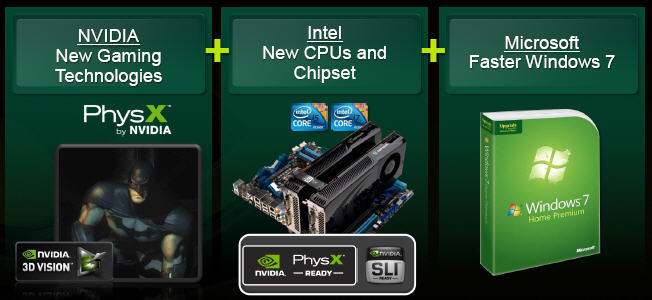
In a recent presentation circulated to sections of the media, NVIDIA put forward a sort of quasi-platform to rival AMD Dragon, although it isn't named or defined, NVIDIA refers to it as "Power of 3". Part of its key components include Intel socket LGA-1156 processor (from the Core i3/i5/i7 series) running on a motherboard with Intel P55 chipset, Windows 7, and two or more NVIDIA GeForce GPUs. To deal with two or more GPUs, NVIDIA defines its existing "NVIDIA SLI Ready" marker and the seemingly new "NVIDIA PhysX Ready" marker. The difference between the two is that the latter lets you install a second (or third) graphics card that is dedicated to PhysX.


While doing so, it also grades P55 chipset motherboards into three tiers: There's a "mainstream" motherboard that has at least one PCI-Express 2.0 x16 slot for graphics, and a second PCI-E x16 slot that is electrically PCI-E x4, that should provide sufficient bandwidth for a PhysX-dedicated accelerator. Then there's a "performance" tier in which, the two (or more) PCI-E x16 slots rearrange as two PCI-E x8 slots when both are populated. This allows two GeForce accelerators to work in a 2-way SLI setup. In some motherboards, a third slot is electrically x4, this can handle the PhysX-dedicated card. Finally, there's the "extreme segment", in which motherboards usually make use of PCI-Express multiplex chips such as the NVIDIA BR-03, to ensure higher operating bandwidth for the graphics cards. This platform allows 3-way SLI, and in some boards with a fourth electrical PCI-E x4 slot to handle a PhysX-dedicated card too. Whew.

NVIDIA further made the licensing part a little more affordable for motherboard vendors. For the X58 platform, motherboard vendors reportedly have to pay a royalty of US $5 per SLI-supportive motherboard they sell. For the new platform, this royalty has been reduced to $3 per board, plus an upfront license fee of $30,000 a motherboard manufacturer has to pay once. A licensee then gets a BIOS micro-code entry that lets NVIDIA GeForce drivers recognise the motherboard as a qualified platform.

With quad-core Core i5 processors starting at US $196, and motherboards starting at well within the $150 mark, NVIDIA claims that it will provide consumers a better performing, and higher value for money platform (compared to AMD Dragon). As for AMD, it is on the brink of unveiling a new generation of GPUs, and will launch newer chipsets as the year progresses. The battle promises to be bitter for the long-standing market rivals, and hopefully sweet for you and me.

Sources: Hardware Canucks, Expreview, Digital Alliance

Friday, August 21, 2009

Original Anti-Viruses

AVG Antivirus 1 User $32
AVG Internet Security 1 User $54
Kaspersky Antivirus 2009 1 User $18
Kaspersky Antivirus 2009 3 User $29
McAfee Total Protection 2009 3 User $61
NOD32 Antivirus $39
Norton Antivirus 2009 1 User $30
Norton Antivirus 2009 3 User $55
Norton Internet Security 2009 1 User $44
Norton Internet Security 2009 3 User $61
Norton Internet Security 2009 4 User $112
Norton 360 3 User $68
Zone Alarm 1 User $27
Zone Alarm 3 User $38
Zone Alarm Security Suite $45

Original Softwares

AutoDesk Maya 2008 Unlimited $7259
Borland Delphi 2009 Profesional $1236
Borland Delphi 2009 Enterprise $2745
Corel Draw Graphic Suite X3 $384
Crystal Report 2008 $462
Crystal Report XI Developers $572
Crystal Report XI Server + 5 User Licences $7630
Nero8 $98
Oracle 11 Standard Edition $1045
Oracle 11 Standard Edition + 5 Users $1981
Pinnacle Studio 11 $89
TurboCAD 15 Deluxe $123
Ulead Video Studio 11.5 Plus $90

Adobe Original Softwares

Adobe Acrobat 9 $307
Adobe Audition V3 $379
Adobe After Effect V8 $1085
Adobe Dreamweaver CS4 $433
Adobe Fireworks CS4 $324
Adobe Flash CS4 $760
Adobe PageMaker 7.02 $542
Adobe Photoshop CS4 $764
Adobe Master Collection CS4 $2718

Microsoft Original Softwares

Microsoft Windows XP Home SP2 OEM $90
Microsoft Windows XP Professional SP3 OEM $151
Microsoft Windows Vista HomePremium $158
Microsoft Windows Vista Bussiness $301
Microsoft Windows Vista Ultimate $351
Microsoft Office 2007 Home And Student 3Users $81
Microsoft Office 2007 Small Bussiness (Word, Excel, Power Point, Outlook) $428
Microsoft Office 2007 Ultimate (Word, Excel, Powerpoint, Outlook, Access,etc) $647
Microsoft SQL Server 2008 10 Clients $2605
Microsoft Windows 2008 Server Included 5 Clients $1083
Microsoft Visio Pro 2007 $585
Microsoft Visual Studio 2008 (VB,C++,J#, C#) $305
Microsoft Visual Studio Pro 2008 (VB,C++,J#, C#) $838
Microsoft Visual Fox Pro 9 $676

[About 5000$] ASUS GX-Platform

MotherBoard : ASUS RAMPAGE II Extreme Intel x58 DDR3 3xPci-x16 FSB1600 $543
Processor : Intel Core i7 2.66Ghz FSB1600Mhz Cache 8MB $320
Memory : Corsair 6GB C9DF PC12800 Triple-Channel $326
HardDiskDrive : Western Digital 2TB SATA 7200RPM $328
Optical Drive : ASUS BD-ROM $241
Graphic Card(s) : ASUS Radeon HD4870X2 2GB 256Bit GDDR5 $589
Power Supply : Thermaltake Tough Power 1200W $319
Casing : Thermaltake Cosmos S with Arcylic Side Window (NO PSU) $287
Monitor : LG 32” LCDTV 32LG30 wide 1366x768 HDMI $550
Speaker : Edifier Gaming Audio S550 5.1 2x32W+120W $426
Printer : N/A
Scanner : N/A
Modem : D-Link 56K Internal Modem 56kbps $10
Input Devices : Logitech Gaming Mouse and Keyboard G1 $94
UPS : Prolink 1200VA+AVR $88
GamePad : Logitech RumblePad 2 $39
Sound Card : SoundBlaster X-Fi Titanium Fatal1ty Champion 7.1 PCIE $246
Cooling Device : Thermaltake Big Water 735 Water Cooling $105
Casing Fan(s) : 4x Thermaltake 12mm $3x10
O/S : Microsoft Windows Vista Ultimate SP1 $352
Additional Part : ASUS P1 PhysX PPU Card 128MB $120
Total Budget : $5013

[Under $7000] ASUS GX-Platform

MotherBoard : ASUS RAMPAGE II Formula Intel x48 DDR3 3xPci-x16 FSB1600 $543
Processor : Intel Core2Extreme3.2Ghz FSB1600Mhz QX9770 Cache 12MB $1635
Memory : Corsair 4GB Twin 3X C9DFNV PC16000 Dual-Channel $366
HardDiskDrive : Western Digital 2TB SATA 7200RPM $328
Optical Drive : ASUS BD-ROM $241
Graphic Card(s) : ASUS Radeon HD4870X2 2GB 256Bit GDDR5 $589
Power Supply : Thermaltake Tough Power 1200W $319
Casing : Thermaltake Cosmos S with Arcylic Side Window (NO PSU) $287
Monitor : LG 32” LCDTV 32LG30 wide 1366x768 HDMI $550
Speaker : Edifier Gaming Audio S550 5.1 2x32W+120W $426
Printer : N/A
Scanner : N/A
Modem : D-Link 56K Internal Modem 56kbps $10
Input Devices : Logitech Gaming Mouse and Keyboard G1 $94
UPS : Prolink 1200VA+AVR $88
GamePad : Logitech RumblePad 2 $39
Sound Card : SoundBlaster X-Fi Titanium Fatal1ty Champion 7.1 PCIE $246
Cooling Device : Thermaltake Big Water 735 Water Cooling $105
Casing Fan(s) : 4x Thermaltake 12mm $3x10
O/S : Microsoft Windows Vista Ultimate SP1 $352
Additional Part : ASUS P1 PhysX PPU Card 128MB $120
Total Budget : $6734

Comment
This spec is only for people who have infinite money on his pocket, this spec is very powerful using Intel Core2Extreme 3.2Ghz and you can overclock it to 4Ghz :D
With 4GB of RAM you can play the high-end games without jaggy effect and using an ATi Radeon HD4870X2 connected by HDMI Cable to LG LCDTV32" what a great sensation playing HD Quality games in big screen?
We Suggest you this spec if you want hardcorest gaming PC in the world :D

[Under $5000] ASUS GX-Platform

MotherBoard : ASUS P5Q Deluxe Wi-Fi AP@n Intel P45, DDR3, 3xPci-x16, FSB1600 $294
Processor : Intel Core2Quad 2.83Ghz FSB1333Mhz Q9550 Cache 12MB $300
Memory : Corsair 4GB Twin 3x C9DFNV PC16000 Dual-Channel $366
HardDiskDrive : Western Digital 2TB SATA 7200RPM $328
Optical Drive : ASUS BD-ROM $241
Graphic Card(s) : ASUS Radeon HD4870X2 2GB 256Bit GDDR5 $515
Power Supply : Thermaltake Tough Power 1200W $319
Casing : Thermaltake Cosmos S with Arcylic Side Window (NO PSU) $287
Monitor : LG 32” LCDTV 32LG30 wide 1366x768 HDMI $550
Speaker : Edifier Gaming Audio S550 5.1 2x32W+120W $426
Printer : N/A
Scanner : N/A
Modem : D-Link 56K Internal Modem 56kbps $10
Input Devices : Logitech Gaming Mouse and Keyboard G1 $94
UPS : Prolink 1200VA+AVR $88
GamePad : Logitech RumblePad 2 $39
Sound Card : SoundBlaster X-Fi Titanium Fatal1ty Champion 7.1 PCIE $246
Cooling Device : Thermaltake Big Water 735 Water Cooling $105
Casing Fan(s) : 4x Thermaltake 12mm $3x10
O/S : Microsoft Windows Vista Ultimate SP1 $352
Additional Part : ASUS P1 PhysX PPU Card 128MB $120
Total Budget : $4830

[Under $1000] GIGABYTE G-Platform

MotherBoard : GIGABYTE GA-EP45 UD3LR Intel P45 DDR2, Pci-x16 FSB1600 $160
Processor : Intel Core2Duo 3.0Ghz FSB1333Mhz E8400 Cache 6MB $183
Memory : Corsair 2GB Twin 2X PC6400 Dual-Channel $36
HardDiskDrive : Western Digital 250GB SATA 7200RPM $47
Optical Drive : Samsung DVD-RW 20x $24
Graphic Card(s) :Digital AllianceHD4670 512MB 128Bit DDR3 $93
Power Supply : GIGABYTE Superb 550W $64
Casing : Simbadda Sim-Cool 430w $50
Monitor : LG 17” LCD L177WFB 5ms 5000:1 Wide $138
Speaker :Sonic Gear 5.1 Spectra 2000 28W $47
Printer : N/A
Scanner : N/A
Modem : D-Link 56K Internal Modem 56kbps $10
Input Devices : Logitech Multimedia Mouse and Keyboard $22
Casing Fan(s) : Cooler Master 120mm SILENT x3 $7x3
UPS : Prolink 650VA $43
Total Budget : $981

[Under $1000] ASUS G-Platform

MotherBoard : ASUS M2A-MX AMD770, DDR2, Pci-x16 $68
Processor : AMD Phenom X4 9950+ 2.6Ghz Cache 4x512kb Black Edition $173
Memory : Corsair 2GB Twin 2X PC6400 Dual-Channel $36
HardDiskDrive : Western Digital 250GB SATA 7200RPM $47
Optical Drive : ASUS DVD-RW 20x $33
Graphic Card(s) : ASUS Radeon HD4650 1GB 128Bit DDR2 $83
Power Supply : ASUS 500W $80
Casing : Simbadda Sim-Cool 430w $50
Monitor : LG 17” LCD L177WFB 5ms 5000:1 Wide $138
Speaker :Sonic Gear 5.1 Spectra 2000 28W $47
Printer : N/A
Scanner : N/A
Modem : D-Link 56K Internal Modem 56kbps $10
Input Devices : Logitech Multimedia Mouse and Keyboard $22
Cooling Device : ASUS Silent Square EVO $68
Casing Fan(s) : Cooler Master 120mm SILENT x3 $7x3
UPS : Prolink 650VA $43
Total Budget : $961

[Under $1000] ASUS G-Platform

MotherBoard : ASUS P5Q Intel P45, DDR2, Pci-x16, FSB1600 $175
Processor : Intel Core2Quad 2.3Ghz FSB1333Mhz Q8200 Cache 4MB $185
Memory : Corsair 2GB Twin 2X PC6400 Dual-Channel $36
HardDiskDrive : Western Digital 250GB SATA 7200RPM $47
Optical Drive : ASUS DVD-RW 20x $33
Graphic Card(s) : ASUS Radeon HD4650 1GB 128Bit DDR2 $83
Power Supply : ASUS 500W $80
Casing : Simbadda Sim-Cool 430w $50
Monitor : LG 17” LCD L177WFB 5ms 5000:1 Wide $138
Speaker :Sonic Gear 5.1 Spectra 2000 28W $47
Printer : N/A
Scanner : N/A
Modem : D-Link 56K Internal Modem 56kbps $10
Input Devices : Logitech Multimedia Mouse and Keyboard $22
UPS : Prolink 650VA $43
Total Budget : $992

[Under $1000] ASUS G-Platform

MotherBoard : ASUS P5Q Intel P45, DDR2, Pci-x16, FSB1600 $175
Processor : Intel Core2Duo 3.0Ghz FSB1333Mhz E8400 Cache 6MB $183
Memory : Corsair 2GB Twin 2X PC6400 Dual-Channel $36
HardDiskDrive : Western Digital 250GB SATA 7200RPM $47
Optical Drive : ASUS DVD-RW 20x $33
Graphic Card(s) : ASUS Radeon HD4650 1GB 128Bit DDR2 $83
Power Supply : ASUS 500W $80
Casing : Simbadda Sim-Cool 430w $50
Monitor : LG 17” LCD L177WFB 5ms 5000:1 Wide $138
Speaker :Sonic Gear 5.1 Spectra 2000 28W $47
Printer : N/A
Scanner : N/A
Modem : D-Link 56K Internal Modem 56kbps $10
Input Devices : Logitech Multimedia Mouse and Keyboard $22
UPS : Prolink 650VA $43
Total Budget : $990

[Under $800] Intel Core2Duo Platform

MotherBoard : GIGABYTE GA-G31M-ES2C Intel G31, DDR2, Pci-x16, FSB 1333 $69
Processor : Intel Core2Duo 2.6Ghz FSB1066Mhz E7300 Cache 3MB $116
Memory : Elixir 2GB DDR2 PC6400 $23
HardDiskDrive : Seagate 160GB 7200RPM SATA $44
Optical Drive : Samsung DVD-RW 20x $24
Graphic Card(s) : Digital Alliance Ati Radeon X1650 512MB 128Bit DDR2 $41
Casing : Simbadda SIM-C 430W $43
Monitor : LG 17” LCD L177WFB 5ms 5000:1 Wide $138
Speaker : Simbadda CST6000N $27
Printer : Canon IP300 $36
Scanner : Canon Lide25 $54
Modem : D-Link 56K Internal Modem 56kbps $10
Input Devices : Simbadda SM322 Optical Mouse and Simbadda SK922 Keyboard $12
Additional Part : Pinnacle Studio MovieBoard PCI500 $138
Total Budget : $775

[Under $650] Intel Core2Duo Platform

MotherBoard : GIGABYTE GA-G31M-ES2C Intel G31, DDR2, Pci-x16, FSB 1333 $69
Processor : Intel Core2Duo 2.6Ghz FSB1066Mhz E7300 Cache 3MB $116
Memory : Elixir 2GB DDR2 PC6400 $23
HardDiskDrive : Seagate 160GB 7200RPM SATA $44
Optical Drive : Samsung DVD-RW 20x $24
Graphic Card(s) : Digital Alliance Ati Radeon X1650 512MB 128Bit DDR2 $41
Casing : Simbadda SIM-C 430W $43
Monitor : LG 17” LCD L177WFB 5ms 5000:1 Wide $138
Speaker : Simbadda CST6000N $27
Printer : Canon IP300 $36
Scanner : Canon Lide25 $54
Modem : D-Link 56K Internal Modem 56kbps $10
Input Devices : Simbadda SM322 Optical Mouse and Simbadda SK922 Keyboard $12
Total Budget : $637

[Under $650] Intel Core2Duo Platform

MotherBoard : GIGABYTE GA-G31M-ES2C Intel G31, DDR2, Pci-x16, FSB 1333 $69
Processor : Intel Core2Duo 2.6Ghz FSB1066Mhz E7300 Cache 3MB $116
Memory : Elixir 2GB DDR2 PC6400 $23
HardDiskDrive : Seagate 160GB 7200RPM SATA $44
Optical Drive : Samsung DVD-RW 20x $24
Graphic Card(s) : Digital Alliance GeForce8400GS 256MB 64Bit DDR2 $39
Casing : Simbadda SIM-C 430W $43
Monitor : LG 17” LCD L177WFB 5ms 5000:1 Wide $138
Speaker : Simbadda CST6000N $27
Printer : Canon IP300 $36
Scanner : Canon Lide25 $54
Modem : D-Link 56K Internal Modem 56kbps $10
Input Devices : Simbadda SM322 Optical Mouse and Simbadda SK922 Keyboard $12
Total Budget : $635

[Under $500] AMD AthlonX2 Platform

MotherBoard : MSI K9N6P6M2-V GeForce6100, DDR2, Pci-x16 $76
Processor :AMD AthlonX2 2.6Ghz 5050e Cache 2x512kb $63
Memory : V-Gen 2GB DDR2 PC6400 $27
HardDiskDrive :Western Digital 80GB 7200RPM SATA $36
Optical Drive : Samsung DVD-RW 20x $24
Graphic Card(s) : Digital Alliance Radeon HD2400SONIC 256MB 64Bit DDR2 $32
Casing : Simbadda SIM-C 430W $43
Monitor : Standard 17” CRT Monitor $70
Speaker : Logitech S100 2.0 Speakers $9
Printer : Canon IP300 $36
Scanner : N/A
Modem : D-Link 56K Internal Modem 56kbps $10
Input Devices : Simbadda SM322 Optical Mouse and Simbadda SK922 Keyboard $12
Total Budget : $438

[About $400] AMD AthlonX2 Platform

MotherBoard : MSI K9N6P6M2-V GeForce6100, DDR2, Pci-x16 $76
Processor :AMD AthlonX2 2.6Ghz 5050e Cache 2x512kb $63
Memory : V-Gen 2GB DDR2 PC6400 $27
HardDiskDrive :Western Digital 80GB 7200RPM SATA $36
Optical Drive : Samsung DVD-RW 20x $24
Graphic Card(s) : N/A
Casing : Simbadda SIM-C 430W $43
Monitor : Standard 17” CRT Monitor $70
Speaker : Logitech S100 2.0 Speakers $9
Printer : Canon IP300 $36
Scanner : N/A
Modem : D-Link 56K Internal Modem 56kbps $10
Input Devices : Simbadda SM322 Optical Mouse and Simbadda SK922 Keyboard $12
Total Budget : $406

Under $500] Intel Core2Duo Platform

MotherBoard : ECS G31T-M7 IntelG31, DDR2, Pci-x16, FSB1333 $58
Processor :Intel Core2Duo 2.6Ghz FSB1066Mhz E7300 Cache 3MB $116
Memory : Elixir 2GB DDR2 PC6400 $23
HardDiskDrive : Seagate 160GB 7200RPM SATA $44
Optical Drive : Samsung DVD-RW 20x $24
Graphic Card(s) : Digital Alliance GeForce8400GS 256MB 64Bit DDR2 $39
Casing : Simbadda SIM-C 430W $43
Monitor : Standard 17” CRT Monitor $70
Speaker : Logitech S100 2.0 Speakers $9
Printer : Canon IP300 $36
Scanner : N/A
Modem : D-Link 56K Internal Modem 56kbps $10
Input Devices : Simbadda SM322 Optical Mouse and Simbadda SK922 Keyboard $12
Total Budget : $484

[Under $500] Intel Core2Duo Platform

MotherBoard :ECS G31T-M7 IntelG31, DDR2, Pci-x16, FSB1333 $58
Processor :Intel Core2Duo 2.6Ghz FSB1066Mhz E7300 Cache 3MB $116
Memory : Elixir 2GB DDR2 PC6400 $23
HardDiskDrive : Seagate 160GB 7200RPM SATA $44
Optical Drive : Samsung DVD-RW 20x $24
Graphic Card(s) : Digital Alliance Ati Radeon X1650 512MB 128Bit DDR2 $41
Casing : Simbadda SIM-C 430W $43
Monitor : Standard 17” CRT Monitor $70
Speaker : Logitech S100 2.0 Speakers $9
Printer : Canon IP300 $36
Scanner : N/A
Modem : D-Link 56K Internal Modem 56kbps $10
Input Devices : Simbadda SM322 Optical Mouse and Simbadda SK922 Keyboard $12
Total Budget : $486

[Under $500] Intel Core2Duo Platform

MotherBoard :Biostar GeForce 7100 M7 GeForce7100, DDR2, Pci-x16, FSB1333 $63
Processor :Intel Core2Duo 2.6Ghz FSB1066Mhz E7300 Cache 3MB $116
Memory : Elixir 2GB DDR2 PC6400 $23
HardDiskDrive : Seagate 160GB 7200RPM SATA $44
Optical Drive : Samsung DVD-RW 20x $24
Graphic Card(s) : N/A
Casing : Simbadda SIM-C 430W $43
Monitor : Standard 17” CRT Monitor $70
Speaker : Logitech S100 2.0 Speakers $9
Printer : Canon IP300 $36
Scanner : N/A
Modem : D-Link 56K Internal Modem 56kbps $10
Input Devices : Simbadda SM322 Optical Mouse and Simbadda SK922 Keyboard $12
Total Budget : $450

[Under $500] Intel Pentium 4 Platform

MotherBoard : ASUS P5GC-MX Intel945GC, DDR2, Pci-x16, FSB1333OC $63
Processor :Intel Pentium 4 3.2Ghz FSB800Mhz 541 Cache 1MB $67
Memory : Kingston 2GB DDR2 PC6400 $28
HardDiskDrive : Seagate 160GB 7200RPM SATA $44
Optical Drive : Samsung DVD-RW 20x $24
Graphic Card(s) : N/A
Casing : Simbadda SIM-C 430W $43
Monitor : Standard 17” CRT Monitor $70
Speaker : Logitech S100 2.0 Speakers $9
Printer : Canon IP300 $36
Scanner : N/A
Modem : D-Link 56K Internal Modem 56kbps $10
Input Devices : Simbadda SM322 Optical Mouse and Simbadda SK922 Keyboard $12
Total Budget : $406

[Under $300] AMD AthlonLE Platform

MotherBoard : Manli Ge Force 6100 GeForce6100, DDR2, Pci-x16 $49
Processor : AMD AthlonLE 2.2Ghz Cache 1MB $39
Memory : MVM 2GB DDR2 PC5300 $24
HardDiskDrive : Seagate 80GB 7200RPM SATA $38
Optical Drive : Samsung DVD-RW 20x $24
Graphic Card(s) : N/A
Casing : Simbadda SIM-V 380W $27
Monitor : Standard 17” CRT Monitor $70
Speaker : Logitech S100 2.0 Speakers $9
Printer : N/A
Scanner : N/A
Modem : N/A
Input Devices : Simbadda SM322 Optical Mouse and Simbadda SK922 Keyboard $12
Total Budget : $292

[About $300] Intel Pentium 4 Platform

MotherBoard : Extreme 945 Intel945, DDR2, Pci-x16, FSB1333 $42
Processor : Intel Pentium 4 3.0 Ghz FSB800Mhz 531 Cache 1MB $57
Memory : MVM 2GB DDR2 PC5300 $24
HardDiskDrive : Seagate 80GB 7200RPM SATA $38
Optical Drive : Samsung DVD-RW 20x $24
Graphic Card(s) : N/A
Casing : Simbadda SIM-V 380W $27
Monitor : Standard 17” CRT Monitor $70
Speaker : Logitech S100 2.0 Speakers $9
Printer : N/A
Scanner : N/A
Modem : N/A
Input Devices : Simbadda SM322 Optical Mouse and Simbadda SK922 Keyboard $12
Total Budget : $303

Comment
This is the most flexible spec in this category, using an Intel Pentium 4 3.0Ghz and using 2GB of DDR2 Memory, and this spec have a PCI-x16 VGA Slot, so if you have more money you can upgrade it to better one. we recommend you this spec because this spec is cheap and flexible to upgrade. :D

[Under $300] Intel Celeron Platform

MotherBoard : Biostar 1865GV Micro 775SE intel865GV, DDR, Agp8x, FSB1066 $40
Processor : Intel Celeron 1.8Ghz FSB800Mhz 430 Cache 512kb $40
Memory : Apacer 512MB DDR PC3200 $20
HardDiskDrive : Seagate 80GB 7200RPM SATA $38
Optical Drive : Samsung DVD-RW 20x $24
Graphic Card(s) : N/A
Casing : Simbadda SIM-V 380W $27
Monitor : Standard 17” CRT Monitor $70
Speaker : Logitech S100 2.0 Speakers $9
Printer : N/A
Scanner : N/A
Modem : N/A
Input Devices : Simbadda SM322 Optical Mouse and Simbadda SK922 Keyboard $12
Total Budget : $280

Comment
This is an under $300 PC Specification, using an Intel Celeron 1.8Ghz and 512MB of DDR Memory, this spec is not bad but you can't upgrade it to a better components because DDR memory is very rare and expensive and AGP8x VGA card is rare too.
But if you are a newbie in computer world, this spec is not bad to you. :p

About Us

PC-Specs
We are here to help you choosing an efficient hardware

combinations for your new PC, you can choose many
combinations with affordable price and efficient performance.